By Chris Skinner, Security Technology Director
This year for Teacher Appreciation Week, Tech Electronics wanted to take the time to provide some tips for how teachers and administrators can go about implementing PASS guidelines in their classrooms.
The Partner Alliance for Safer Schools was founded in 2014 and with help from the National Systems Contractors Association and the Security Industry Association, published the first Safety and Security Guidelines for K-12 Schools.
The Alliance has now grown to include security manufacturers and integrators like Tech Electronics, and they released the seventh edition of their guidelines just last year.
Policies and Procedures
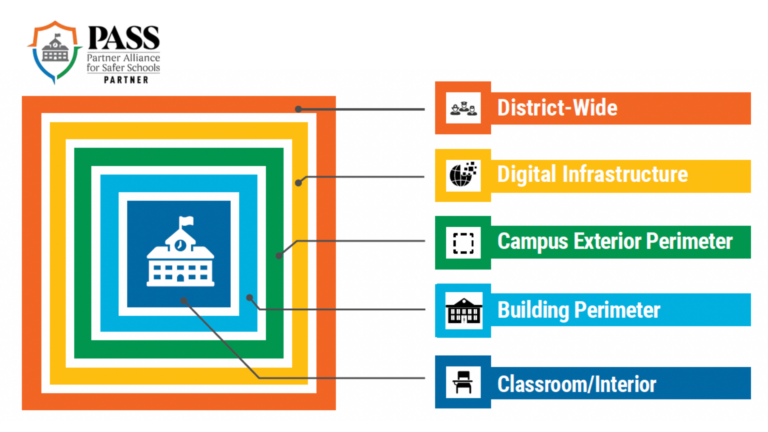
PASS guidelines outline four tiers of security for K-12 institutions with focuses on each layer of security from district-wide, down to the individual classrooms.
Even if a district has adhered to all the requirements across all layers and tiers, without the proper policies and procedures, those measures could fall flat in the face of a real emergency.
Procedures define who is responsible for what in the case of an emergency, what teachers need to do, and where people need to be for the school’s security stack to work as intended.
The Classroom
The classroom is the very inner layer of security and is where some of these security measures can be the most impactful. One development in this layer has been through Alyssa’s Law.
Alyssa’s Law is named for Alyssa Alhadeff, 14, who was tragically lost in the mass shooting at Marjory Stoneman Douglas High School in Parkland Fl., in 2018. Since then, it has been passed in 11 states with legislation pending in another 18.
The law requires school buildings to be equipped with silent panic alarms connected to local law enforcement.
There are several ways these panic alarms can be implemented, with wearable panic buttons for teachers and wall-mounted panic buttons in classrooms being the most common options.
Even with these measures implemented, having the correct procedures in place is vital so that students or teachers are comfortable using the equipment without hesitation when the situation calls for it.
Wireless locks can also be installed and integrated with security systems and panic buttons to automatically lock classrooms when an alarm is raised.
Building Perimeter
Any point of entry on the building also represents a point of failure. It doesn’t matter if the side door is equipped with a lock if teachers or students frequently prop open a door for convenience.
Every door to the building should be equipped with access control, and video surveillance. This ensures that only those who are authorized to enter gain access and administrators can track who is using which doors.
When budget constraints limit the number of cameras a school or district can install, access control systems with door alerts can also notify administrators when a door has been propped open so the issue can be addressed promptly.
Campus Perimeter
The campus perimeter is the third layer of security outside of the individual classrooms and like the building perimeter, every entrance also represents a point of failure.
AI-powered analytics paired with the latest cameras and video surveillance systems can provide a comprehensive view of any campus. Cameras can track license plates and can alert security personnel if a plate that is barred from entry attempts to drive into the parking lot.
These video surveillance systems can also learn what regular campus activity looks like and notify administrators when something unusual or abnormal happens. Measures like these are particularly important if the cameras are equipped with brandished weapon detection.
The software is trained to recognize different types of brandished weapons, and when one is detected, the image is directed to the security officer of the school or district for confirmation.
For more information on how PASS guidelines can be applied in your district, schedule a consultation with one of our security experts.